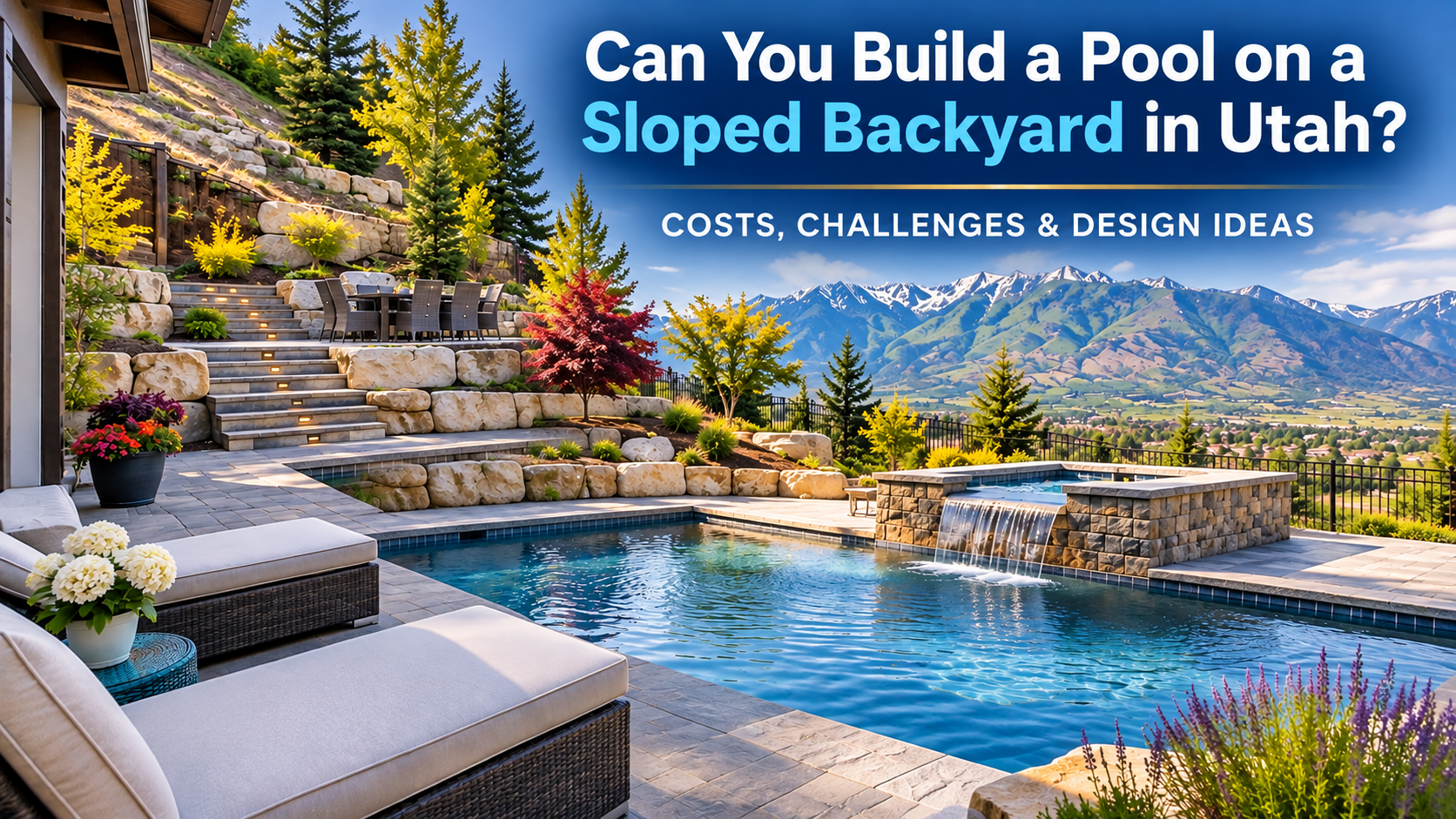
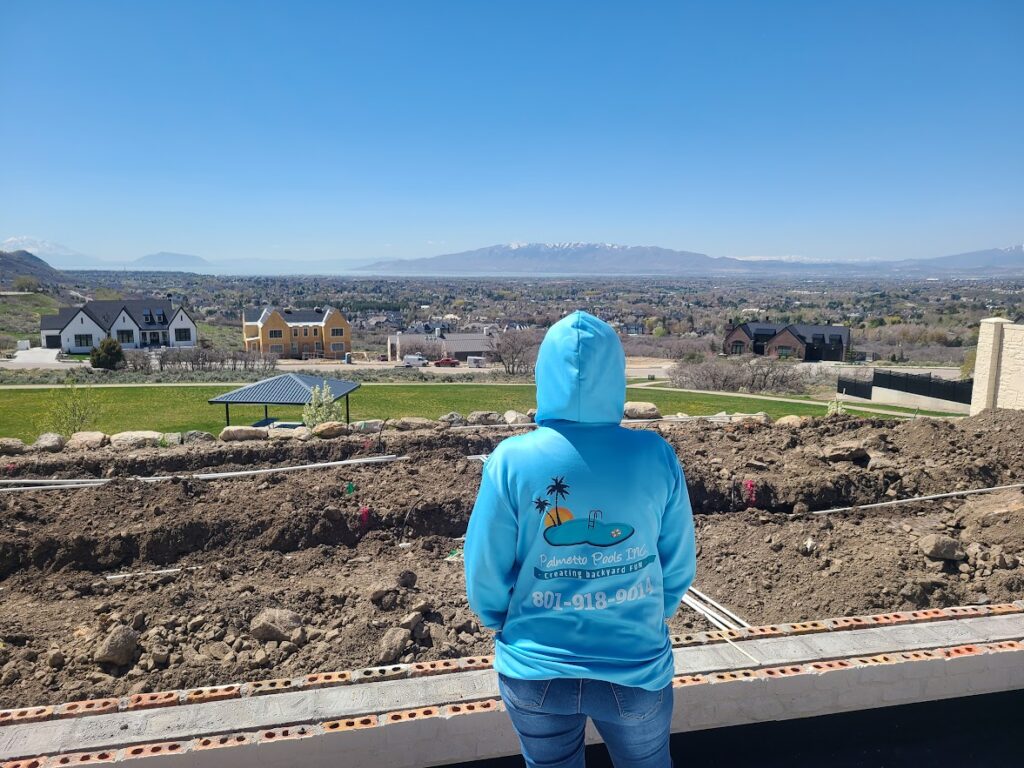
A sloped backyard can make building a swimming pool seem impossible. Maybe your property drops several feet toward the back fence, sits against a hillside, or has an uneven layout that doesn’t seem suited for a traditional inground pool.
For homeowners throughout northern Utah, these challenges are fairly common. Between the foothills of the Wasatch Mountains, hillside neighborhoods, and properties with significant elevation changes, not every backyard offers a perfectly level place to build.
But here’s something many homeowners don’t realize: a sloped backyard doesn’t automatically prevent you from building a swimming pool.
In some cases, the slope can actually become one of the most interesting features of the design.
The key is understanding what your property will require before construction begins. Excavation, retaining walls, drainage, structural engineering, equipment access, and the pool’s position within the yard can all affect the project’s cost and complexity.
If you’ve been wondering whether you can build a pool on a hill or uneven backyard in Utah, here’s what you should know before ruling out your property.
TL;DR: Building a Pool on a Sloped Yard in Utah
- Yes, swimming pools can be built on many sloped properties. The right construction method depends on the slope, soil conditions, access, and structural requirements.
- Custom gunite pools offer considerable design flexibility for hillside properties, including irregular shapes, elevated walls, and multi-level outdoor living spaces.
- Retaining walls, engineered foundations, additional excavation, and drainage improvements can increase construction costs.
- Not every sloped yard needs extensive retaining walls. Some properties can be graded or designed around their existing elevation.
- A slope can create opportunities for raised spas, vanishing edges, terraced patios, and mountain-facing pool designs.
- A site evaluation is the best way to determine what’s feasible and establish a realistic construction budget.
Quick Answer: Can You Build an Inground Pool on a Sloped Backyard?
Yes. Many sloped backyards in Utah can accommodate an inground swimming pool with the right design and construction approach. Depending on the property’s elevation changes, builders may use grading, retaining walls, engineered pool structures, or a combination of these methods to create a stable installation.
However, the feasibility and cost depend on site-specific conditions, including soil stability, excavation access, drainage, property setbacks, and local engineering requirements. A professional site evaluation is necessary before determining which construction method is appropriate.
Why Sloped Backyards Are Common in Northern Utah
Utah’s landscape is one of the reasons so many homeowners love living here. Mountain views, hillside neighborhoods, and properties overlooking the valley create beautiful settings for outdoor living.
Those same features can also complicate backyard construction.
A home built along the foothills in Draper or Highland may have a significant elevation change between the house and the rear property line. Properties in parts of Bountiful, North Ogden, or other hillside communities may have natural slopes that affect where a pool can be positioned.
Even relatively flat-looking backyards can have grading differences that become important once excavation begins.
The challenge isn’t necessarily the slope itself. It’s understanding how the land behaves and what will be required to support a permanent, water-filled structure.
Swimming pools carry substantial loads, and the surrounding soil, foundation conditions, and drainage must be evaluated accordingly. A pool built on a hillside may need a very different structural approach from one installed on a level suburban lot.
That’s why a design that works beautifully on one Utah property might be completely inappropriate for another just a few streets away.
Is Your Backyard Too Steep for a Swimming Pool?
One of the first questions homeowners ask is whether there’s a maximum slope that makes pool construction impossible.
Unfortunately, there isn’t a single percentage or elevation change that answers that question for every property.
A gently sloped yard may only require relatively straightforward grading. A steeper property might need retaining walls, specialized foundations, or an elevated structural design.
Other factors can be just as important as the slope itself.
For example, a backyard with a moderate incline but excellent equipment access may be easier to develop than a relatively flat property where excavation machinery cannot reach the construction area.
Similarly, a hillside with stable underlying conditions may present different challenges from a property with uncontrolled fill, groundwater, or unstable soils.
Before deciding whether a pool is feasible, a builder needs to evaluate the actual property.
The important takeaway is that a difficult backyard isn’t necessarily an unusable backyard. It may simply require a different design and construction strategy.
How Pool Builders Handle Sloped Backyards
There are several ways to incorporate a swimming pool into an uneven property. The right approach depends on the site, the homeowner’s goals, and the engineering requirements.
Grading the Yard to Create a Level Pool Area
For properties with relatively modest elevation changes, grading may be the most straightforward solution.
This involves reshaping portions of the yard to establish a suitable area for the pool and surrounding patio.
Depending on the existing terrain, soil may need to be excavated from higher areas, removed from the property, or placed as engineered fill where permitted and appropriate.
However, grading isn’t simply a matter of moving dirt until the yard looks level. The finished elevations must work with the home’s foundation, surrounding properties, drainage patterns, and structural requirements.
A grading plan that creates a flat pool area but directs stormwater toward the house would introduce a much larger problem.
That’s why proper site planning is essential.
Using Retaining Walls to Manage Elevation Changes
Retaining walls are another common solution for sloped pool projects.
They allow different portions of the backyard to remain at separate elevations while providing structural support where necessary.
For example, a pool may sit on a level terrace with a retaining wall supporting the higher landscape behind it. On another property, a retaining structure may support the pool deck above a lower portion of the yard.
The wall’s design depends on factors such as soil pressure, drainage, height, proximity to the pool, and the loads it must support.
Some retaining walls require engineered foundations, reinforcement, and specialized drainage systems. Depending on their size and location, they may also require separate permits or structural review.
The important distinction is that a retaining wall near a swimming pool isn’t necessarily just a landscaping feature. It may be a critical structural component of the project.
Building an Elevated or Partially Exposed Pool
Sometimes the most interesting solution is to work with the slope rather than eliminate it.
A custom gunite pool can be designed with portions of the structure extending above the surrounding grade, subject to appropriate structural engineering.
This approach can be particularly appealing on properties with substantial elevation changes or scenic views.
Instead of trying to make the entire backyard flat, the design can use the existing terrain to create multiple levels, raised walls, or a pool that visually overlooks the landscape.
These projects are often more complex than conventional inground installations, but they can also produce distinctive outdoor spaces that would be difficult to achieve on a flat lot.
Why Gunite Pools Are Worth Considering for Sloped Properties
When homeowners begin researching swimming pools for hillside properties, one of the most important decisions is which construction method provides the flexibility their property requires.
Custom gunite pools are particularly well suited to projects where the shape, dimensions, elevations, or structural configuration need to be tailored to the site.
Unlike prefabricated pool shells, gunite construction allows the pool structure to be designed around a much wider range of configurations, subject to engineering and site conditions.
That flexibility can be useful when working around unusual lot shapes, retaining structures, elevation changes, or architectural features.
For example, a homeowner may want the pool positioned to preserve a mountain view while incorporating a raised spa and patio at a different elevation. A custom gunite design can accommodate that vision without requiring the entire backyard to conform to a standard pool shape.
Of course, gunite isn’t automatically the best choice for every property. Construction cost, site access, soil conditions, and design requirements should all be considered.
If you’re still comparing construction methods, our guide to Gunite vs. Fiberglass Pools in Utah explains the differences and what homeowners should consider before choosing.
How Much More Does It Cost to Build a Pool on a Slope in Utah?
This is where homeowners need to be especially careful with online cost estimates.
You’ll sometimes see claims that a sloped backyard automatically adds a certain percentage to the price of a swimming pool.
In reality, there isn’t a reliable flat surcharge that applies to every hillside pool project.
A backyard with a minor grade change may require relatively little additional work. Another property with substantial elevation differences, difficult access, unstable soils, or extensive retaining structures could require significant engineering and site preparation.
The additional cost is driven by the work necessary to make the property suitable for construction.
Excavation and Soil Removal
Excavation is often one of the first major variables.
Rocky ground, difficult digging conditions, limited access, and the amount of material that must be removed can all affect cost.
In some situations, specialized equipment may be required. On others, transporting excavated material away from the property becomes a significant expense.
Retaining Walls and Structural Engineering
Retaining walls can introduce additional expenses for excavation, foundations, reinforcement, drainage, materials, and labor.
Where structural engineering is necessary, those design and review costs also become part of the project budget.
Access for Construction Equipment
A narrow side yard, steep driveway, neighboring structures, or limited access to the backyard can complicate construction even when the pool location itself is relatively straightforward.
Smaller equipment, additional material handling, or specialized placement methods may be necessary.
Drainage and Site Preparation
Managing water movement is particularly important on sloped properties.
Depending on the site, the project may require drainage improvements, erosion-control measures, grading adjustments, or other work to protect the pool and surrounding structures.
These aren’t optional details that should be ignored to reduce the initial estimate.
They’re part of building the project correctly.
What Should Homeowners Budget?
Rather than offering a generic hillside construction premium, we recommend starting with a site-specific assessment.
A builder can evaluate the property, discuss the desired pool layout, identify potential complications, and determine whether additional engineering or investigation is necessary before establishing a detailed budget.
For a broader understanding of swimming pool construction pricing, read our guide to How Much Does a Pool Cost in Utah?.
That article explains the primary factors affecting custom pool costs, while a property evaluation helps determine how your specific terrain may change the scope.
Drainage Is One of the Most Important Parts of Hillside Pool Construction
When homeowners imagine the challenges of building a pool on a slope, they usually picture excavation and retaining walls.
Drainage is just as important.
Water naturally moves downhill. During heavy rain, snowmelt, or irrigation runoff, a sloped property may direct water toward the pool, patio, retaining structures, or home.
If that movement isn’t accounted for during design, it can contribute to erosion, soil saturation, drainage problems, and damage to surrounding improvements.
Proper planning considers how surface water will move around the completed project, how retaining structures will manage drainage, and whether existing runoff patterns need to be modified.
The goal is to integrate the pool into the property’s drainage system without creating problems for the house or neighboring lots.
Northern Utah’s seasonal conditions make this particularly relevant. Snow accumulation, spring runoff, summer storms, and freeze-thaw cycles all deserve consideration when designing outdoor structures.
For homeowners researching the technical side of site preparation, the Utah Division of Water Rights provides information related to water resources and groundwater matters. Local building departments and qualified geotechnical or civil engineers are the appropriate sources for site-specific grading and drainage requirements.
When a Sloped Backyard Becomes a Design Advantage
Not every challenging lot should be viewed as a problem to overcome.
Sometimes the existing elevation creates opportunities that a completely flat backyard wouldn’t offer.
Vanishing-Edge Pools With Mountain Views
A hillside property overlooking the valley can provide an excellent setting for a vanishing-edge or infinity-edge pool.
These designs create the visual impression that the water extends toward the horizon, often using a catch basin and specialized circulation system to manage water flowing over the edge.
When positioned thoughtfully, the effect can emphasize mountain scenery or distant valley views.
However, infinity-edge construction requires careful structural, hydraulic, and equipment design. It should be evaluated based on the site rather than selected purely for its appearance.
Multi-Level Patios and Outdoor Living Spaces
A sloped property can also accommodate different outdoor living zones at different elevations.
For example, a patio near the house might connect to an outdoor dining area, while a lower terrace contains the swimming pool and lounge seating.
Instead of fighting the natural terrain, the design uses it to organize the backyard.
This approach can make a larger outdoor space feel more interesting and intentional.
Raised Spas and Architectural Water Features
Elevation changes can create opportunities for raised spas, spillways, and carefully positioned water features.
A spa located above the main pool may become a visual focal point, while a spillway can connect the two elements.
The key is restraint.
Not every sloped property needs a dramatic waterfall or complicated multi-level design. Sometimes a simple pool with thoughtful retaining walls, clean landscaping, and a generous patio is the better solution.
For more ideas, explore our guide to Luxury Backyard Pool Design Ideas for Utah Homes.
What About Rocky Soil and Difficult Excavation in Utah?
Rock is another factor that can change a pool construction project.
Some northern Utah properties have relatively straightforward excavation conditions. Others may contain cobbles, boulders, bedrock, or previously disturbed fill.
The presence of rock doesn’t necessarily make pool construction impossible, but it can affect the equipment, excavation methods, timeline, and cost.
A property near the foothills may present different subsurface conditions from a lot located on the valley floor, but location alone cannot establish what’s underground.
That’s why builders should avoid making absolute assumptions about excavation conditions without sufficient site information.
Where the conditions warrant it, a geotechnical investigation may be needed to evaluate soil characteristics, bearing capacity, groundwater, slope stability, and other structural considerations.
This is especially important when a pool will be built near a significant slope, retaining structure, or existing building.
Permits, Setbacks, and Engineering Requirements
Building a swimming pool on a sloped property may involve additional permitting considerations.
Local jurisdictions can regulate pool placement, setbacks, grading, retaining walls, drainage, structural design, and safety barriers.
Requirements vary depending on the municipality, county, and project scope.
For example, homeowners in Draper may encounter different local review procedures from those in North Ogden, Kaysville, or Highland.
Homeowners should also review any applicable HOA requirements before finalizing a design.
The best approach is to identify these restrictions early, before committing to a pool layout that may conflict with setbacks, easements, or other requirements.
For statewide building-code information, the Utah Division of Facilities Construction and Management provides resources related to construction and building standards. Your local building department remains the primary authority for residential pool permit requirements.
What to Ask a Pool Builder Before Starting a Hillside Project
If you’re considering a pool on an uneven property, the initial consultation should involve more than choosing a shape and discussing finishes.
Ask how the builder plans to evaluate the slope and what additional site information may be required.
Find out whether the proposed design could involve retaining walls, structural engineering, specialized excavation, or drainage improvements.
It’s also worth discussing how construction equipment will reach the backyard, where excavated material will go, and how unexpected subsurface conditions will be handled.
Finally, ask how those potential variables are reflected in the proposal.
A clear estimate should distinguish known work from allowances, exclusions, and conditions that could require changes once construction begins.
The goal isn’t to eliminate every unknown. That’s not always possible with excavation.
It’s to understand the risks before work starts so there are fewer surprises later.
Should You Level the Entire Backyard Before Building a Pool?
Not necessarily.
In fact, completely leveling a sloped backyard can sometimes create more work than designing around the existing terrain.
Extensive grading may require larger retaining walls, additional soil removal, more complicated drainage, and changes to landscaping or access.
A thoughtful design may preserve portions of the natural slope while creating level areas only where they’re needed.
For example, the pool and primary patio could occupy one terrace while the remaining yard retains its existing elevation.
This can also create a more natural transition between the home, outdoor living areas, and surrounding landscape.
The best solution depends on the property, not a universal preference for flat yards.
Is a Sloped Backyard Pool Worth the Additional Investment?
That depends on what you want from the property.
If the slope requires extensive structural work, the project may cost more than a comparable pool on a straightforward lot.
But the result can also be something distinctive.
A hillside pool that takes advantage of mountain views, incorporates multiple outdoor living levels, and feels naturally integrated into the landscape may offer an experience that a conventional backyard layout cannot replicate.
The important thing is understanding the full scope before making the investment.
For some homeowners, a simpler design that works with the terrain will provide the best balance of cost and enjoyment.
For others, a more elaborate custom gunite pool may be worth the additional engineering and construction involved.
Neither approach is inherently right or wrong.
The best project is the one that fits the property, the homeowner’s goals, and a realistic budget.
Utah Homeowner Takeaway
A sloped backyard doesn’t mean you have to give up on building a swimming pool.
It means the project deserves a more thoughtful design process.
Throughout northern Utah, uneven terrain, hillside properties, rocky ground, and challenging access can all influence how a custom pool is constructed. Some yards may require relatively straightforward grading, while others benefit from retaining walls, engineered structures, or creative multi-level layouts.
The right solution starts with understanding the land.
Instead of forcing a standard pool design onto a difficult property, consider how a custom pool can work with the existing slope, surrounding architecture, views, and outdoor living areas.
With the right planning, what initially looks like your backyard’s biggest limitation may become one of its most interesting design opportunities.
Planning a Custom Pool on a Sloped Property in Northern Utah?
If you’ve been told your backyard is too steep for a swimming pool, or you’re unsure what construction would involve, the best place to start is with a professional site evaluation.
Palmetto Pools designs and builds custom swimming pools for Utah homeowners, helping turn backyard ideas into practical construction plans.
Whether you’re considering a hillside gunite pool, an integrated spa, a multi-level outdoor living space, or a simpler design that works with your property’s natural elevation, the first step is understanding what’s possible.
Contact Palmetto Pools to discuss your property and schedule a pool design consultation.
Questions about Pool builds
Can you build an inground pool on a sloped backyard in Utah?
Yes. Many sloped properties can accommodate inground swimming pools with appropriate grading, retaining structures, or engineered pool designs. Feasibility depends on the property’s soil conditions, elevation changes, access, drainage, and local requirements.
How much more does it cost to build a pool on a slope?
There is no universal additional cost. Expenses depend on the amount of excavation, retaining walls, engineering, drainage work, equipment access, and other site-specific conditions. A professional site evaluation is needed to establish a realistic budget.
Do you always need a retaining wall for a sloped pool?
No. Some properties can accommodate a pool through grading or a layout that works with the existing terrain. Other sites require retaining walls or specialized structural solutions. The appropriate approach depends on the slope and engineering requirements.
Are gunite pools better for sloped backyards?
Custom gunite construction offers considerable flexibility for unusual shapes, elevation changes, and engineered pool structures. However, the best construction method depends on the specific property, budget, and design requirements.
Can you build an infinity pool on a hillside in Utah?
Potentially, yes. Hillside properties can provide attractive settings for vanishing-edge pools, particularly when they overlook mountains or valleys. These designs require specialized structural and hydraulic planning and must be evaluated for site feasibility.
Does rocky soil prevent pool construction?
Not necessarily. Rocky conditions can complicate excavation and increase construction costs, but they don’t automatically prevent a pool from being built. The type, depth, and extent of rock determine the construction methods required.
Can a sloped backyard be leveled for a pool?
In many cases, portions of a sloped yard can be graded to create a level pool area. However, extensive grading may require retaining walls, drainage improvements, or engineered fill. Sometimes designing around the slope is more practical.
Do hillside pools require special permits in Utah?
They may. Local jurisdictions can require permits or engineering documentation for pool structures, retaining walls, grading, drainage, and related work. Requirements vary by city and project, so homeowners should confirm them with the appropriate local building department.